Planning your once-in-a-lifetime trek in Nepal, but not sure where or how to start? This post is for you.
Come November, school's out for children and teachers alike for a good one and a half months. In 2013, we had shortlisted some possible places to spend our long break in, but a trek in Nepal stood out for us. I'll share the process of planning our trek to Nepal.
1) Decide how you want to book your tickets/tour
We first did some research online on trekking in Nepal in general. Then we found some local travel agencies that could organize the trek, and even book the air tickets. We went down to the shops and asked some questions, including "Have you gone on a trek before?" (Which I think is the single most important question to ask any agency when booking any tour) and "Why should I book now and not upon arrival in Nepal?" You can also decide to reach Kathmandu and search for a Nepali travel agency, or find your guide directly.
Our decision: Book the airtickets ourselves (AirAsia to Kathmandu if you must know), book our accomodation (using hostel booking websites, yes they are legit) and book our tour in Nepal. It's a risk to take, and if you can't take risks, do book early in yyour home country. Upon arrival (the hostel was supposed to pick us up but didn't so we waited for about an 1 h before cabbing there and charging the hostel for it), we shopped around the tour agencies in Thamel (the backpacking district of Kathmandu) before deciding on booking our tour at our hostel (it ran a tour agency too). We are lucky the guide and porter were good and kind people, but again, it's a gamble. So it would be good if you get to speak to your guide before that, afterall, you are will be spending a lot of days with him, and are almost trusting him with your life (altitude sickness can be life-threatening, can you recognise the symptoms?).
2) Decide what kind of trek you want to take
This depends on your fitness levels (or how much you are willing to train before the trip), how many days you have, and what you want to see/ achieve. Of the many treks available, the 3 that we were considering were:
- Everest Base Camp Trek (approx 20 days)
- Annapurna Circuit Trek (18 - 21 days)
- Annapurna Base Camp Trek (7 - 10 days)
Our decision: Before we left, we knew we had many days, but not that many that we want to spend trekking. We were more of leisure trekkers, the type that trekked perhaps once in 5 years (we met avid trekkers on our trek, those that literally trek around the world). In fact our last trip together was a trek in Sapa, Vietnam. Thus, we decided on an ABC trek (sunrise to Poon Hill is included). No regrets. And not sure if I can achieve more than that.
The planning from here on is based mainly on my insights during our ABC trek, in November 2013. I can't speak for the other treks.
3) Train for it
We took 9 days for the trek itself, counting from the day we left Pokhara to the day we arrived back in Pokhara. Along the trekking route, there are "checkpoints" - several villages with teahouses (that provide food and/or accommodation). Based on your progress (determined by factors like acclimatization at high altitudes, fitness level), the guide would space out the trek. Every morning after breakfast, our guide would tell us the "plan" for the day, where we will stop for lunch, where we intend to stay for the night, how much we can spend for meals, what exciting things to see; but these are very much negotiable. The pace of the trek is really flexible, if you want to push yourself further, walk to the next village, if you want to rest early, stop and "check-in" at the village. Usually we would wake up early (like 8-9 am), trek a few hours, have lunch, trek till about 4-5pm and reach the village we were staying at for the night, have dinner, play some dice game (Yahtzee for the win!) and turn in.
Conclusion: Unless you have trained or are training for a marathon, it is strongly advised that you train up for your trek. Climb a few hills (in Singapore, that's all we have) or just climb stairs in HDB flats. We met a group (with a mix of men and women, probably in their 40s and up) from Singapore on their way down and they wanted to give us the Singapore flag (which was a really cool idea!) to take photos with, and they asked if we trained at Bukit Timah Hill. The guilty answer was
no, so we had no chance of meeting them at BTH, and I realised how under-prepared we were. Yes, we survived with little training, but better fitness would have made the trek more enjoyable. Taking photos are less important than making it to the next teahouse in good shape. From my experience, climbing up is simply tedious, but climbing down is
life-threatening. So don't take the lift down when you scale flats! Practise climbing down stairs too!
4) Prepare your gear
Good hiking shoes are a must. We were on a lookout for the best value-for-money hiking shoes for almost a month, and it's good to train and season them too before embarking on your hike. My pair has served me well in Korea (snow and ice) and Europe (long walks in the cities) too. The weather when hiking calls for T-shirts (dry-fit would be good) and pants (or shorts even), because the sun is out and you will work out a sweat. At night, it can be cold but you only have to worry when you get really near the base camp - that's when the Down Jackets and Sleeping Bags (loaned by the tour company, lugged around by your poor porter) will be of use. I feel bad having him carry all our stuff, but they are tough guys (I can't even stand up when carrying his load and he climbs faster than us with his)!
Usually once you reach the teahouse that you are staying, you should bathe as soon as you can, paying for the hot water if necessary (1 USD?), before the sun sets. That night before reaching ABC we didn't shower as it was really cold (the only of 2 nights we needed the sleeping bag). The coldest times were those 2 nights, and waking up before dawn to catch the sunrise at Poon HIll and the walk to ABC. So cold, I thought my fingers would drop off. But despite the reluctance, I think a lifetime of regret is more painful than a moment of suffering (it did feel very bad at the time, one hand with the walking stick, one hand with the torchlight, climbing up, with shortness of breath in the thinning air).
Conclusion: If you come from somewhere warm and sunny most of the year, the down jackets and sleeping bags are a must, even if you have to carry it for 10 days to use it for one (or 2) nights, just tip your porter very well. That said, I've seen people with such a small load, they had no need for porters. Maybe Uniqlo Lightweight Down will suffice? I'm sure they brought thermals too, and heatpacks! Lastly, good gloves and boots with good grips, are very, very important, you don't want frost bite and to slip...
The incomplete packing list:
- down jackets and sleeping bags (which tour companies will usually loan you)
- trekking attire and footwear
- thermals and heatpacks, good gloves and cap
- a small torchlight for hikes in the dark to catch the sunrise
- hot water flask (doubles up as a water bottle), cos wouldn't it nice to have hot water while admiring the sunrise or while snuggling in your down sleeping bag
- camera(s) (in case you forget this). Mounting a gopro on your head or chest is pretty cool. By the way, there was wifi almost only when we were in Kathmandu, but seriously, stay unconnected with technology to stay connected to nature.
- cards/ games to spend your rest time. Before dinner we would entertain ourselves with Yahtzee, it's a pretty light-weight game for travel - just 5 dice, and 1 book. Our guide uses the book to keep score, it was interesting to flip through it.
- a walking stick, bring your own if you have, otherwise our guide got us a wooden stick at Nayapul, works fine for me.
We found a pamphlet someone left behind at a Teahouse near the end of our trek. This shows you how far and how high the teahouse villages along the ABC trek are.
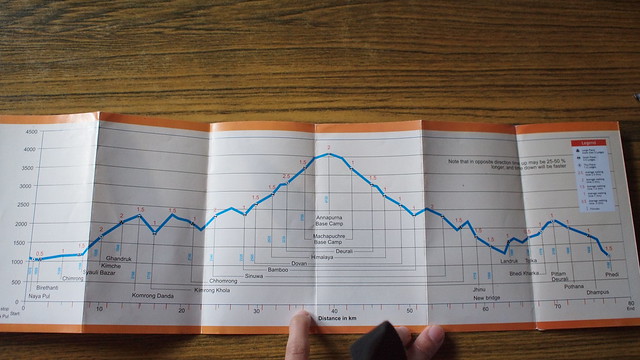
(P.S. I have wondered how many people at the Base Camp really use it as a base to climb the Annapurna massif's peaks. I am guessing not many because Annapurna turns out to be one of the most dangerous to climb, especially with the avalanches.)
More information on the Trek
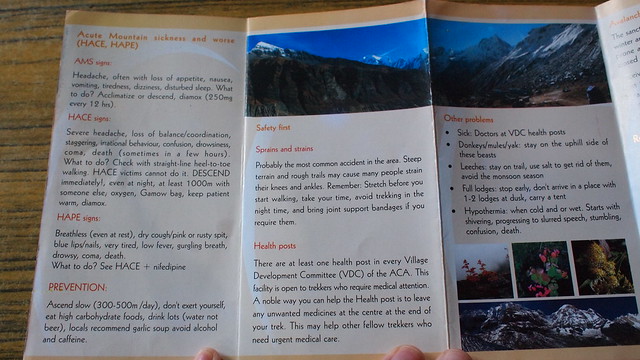
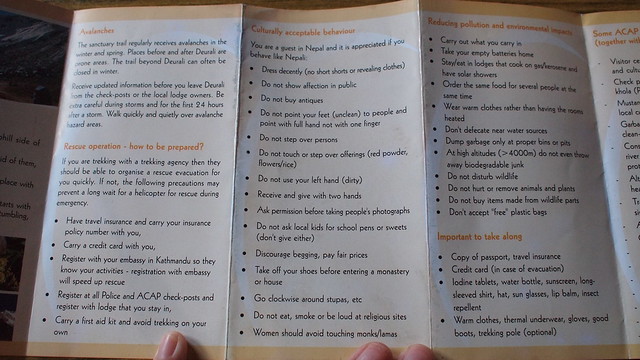
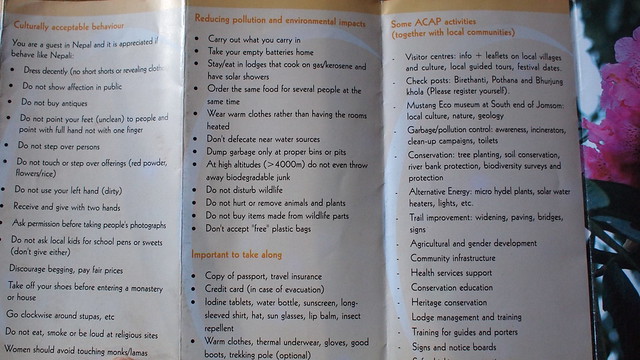
We saw/ heard at least 2 helicopters, probably on rescue operations, because altitude sickness, if not avalanches, are actual risks involved in any trek. A reliable guide is paramount, someone who is
1) Experienced with the trekking routes;
2) Able to set a good pace (the trek up takes longer than the way down for acclimatization);
3) Alert and aware;
4) Friendly with peers and teahouse owners (Guides and porters don't have meals with tourists, they eat together and share important information (and gossip);
5) Pushes you but know your limits (Climbing stairs in the dark up Poon Hill, or trekking in the dark to catch the sunrise at ABC are
not for the weak!)
However, that said, your attitude will also make a difference to your trekking experience:
1) Treat guides and porters with respect, he definitely knows more than you, or is able to carry more than you can, while putting his life at risk, and your life might depend on him (Recall the October 2014 snowstorm disaster at Thorung La Pass, part of the Circuit Trek)
2) Find out more about them, play games (our guide brought dice for games of Yahtzee), take photos together
3) If you order food, offer them some, or buy them drinks
4) Tip well, at market rate or above
Lastly, for your reference, our customised trekking itinerary (Clearly, I haven't been exactly good at tracking our trek.):

Taken from http://www.nepalhikingtrip.com/packages/35/ghorepani-poon-hill-trekking-
(Bus from Kathmandu to Pokhara) 1 Night in Pokhara
Taxi from Pokhara to Nayapul
Day 1: Nayapul to Ulleri
Day 2: Ulleri to (L: Nangethanti) to Ghorepani
Day 3: Ghorepani to (S: Poon Hill) to (Ghorepani) to Tadapani
Day 4: Tadapani to (L: Ghandruk) to Chhomrong
Day 5: Chhomrong to (L: Bamboo) to Deurali
Day 6: Deurali to Machhapuchere Base Camp
Day 7: Macchapuchere to (S: Annapurna Base Camp) to (Macchapuchere) to Deurali/Doban/Bamboo (I can't remember which!)
Day 8: Deurali/Doban/Bamboo to Chhomrong
Day 9: Chhomrong to Syauli Bazar
Day 10: Syauli Bazar to (Birethati) to Nayapul
Taxi from Nayapul to Pokhara
1 Night in Pokhara (Bus from Pokhara to Kathmandu)
*L: Lunch; S: Sunrise
And... I think I've covered most of our planning for our trek. Hope it helps you plan for your trip of a lifetime!
Meanwhile do stay tuned for the
actual adventure.